INTERIOR DESIGN SERVICE
Bathroom Design, Considered and Built to Last
A bathroom must perform daily. Ours are designed to perform beautifully, and to endure.
The bathroom is perhaps the most honest room in any property. It cannot hide beneath soft furnishing or clever lighting. It reveals itself every morning in unforgiving daylight, and its materials—tile, joinery, finishes—will weather decades of moisture and use. This is where restraint becomes virtue. A well-designed bathroom does not announce itself through trend or gesture. It announces itself through the quality of its joinery, the precision of its tile layout, the integrity of its drainage logic, and the permanence of its material choices. We design bathrooms that do not require revision.
Our approach begins with rigorous Discovery—understanding how the space will actually be used, who uses it, what the building itself can accommodate, and where conservation or structural constraints may exist. A Georgian townhouse bathroom presents entirely different problems than a contemporary new-build apartment or a country cottage. The period of construction, the existing services, the quality of the plasterwork, the height of ceilings, and the quality of natural light all determine what is possible and, more importantly, what is honest. We do not impose aesthetic onto circumstance. We work within it.
In our Concept phase, we establish material palettes and spatial logic that will sustain the design through detailed specification. This is not the stage for flourish. This is the stage for rigorous questioning: which materials will perform in this humidity? Will grout or sealed stone wear better over twenty years? Can tiling be laid in a way that honours the room's proportions rather than obscuring them? Are we choosing finishes that will develop patina gracefully, or finishes that will look dated the moment fashion moves? We have completed bathroom projects across residential properties in London, in Witham, and throughout the UK, each with material and spatial decisions that were earned through constraint rather than chosen from a mood-board.
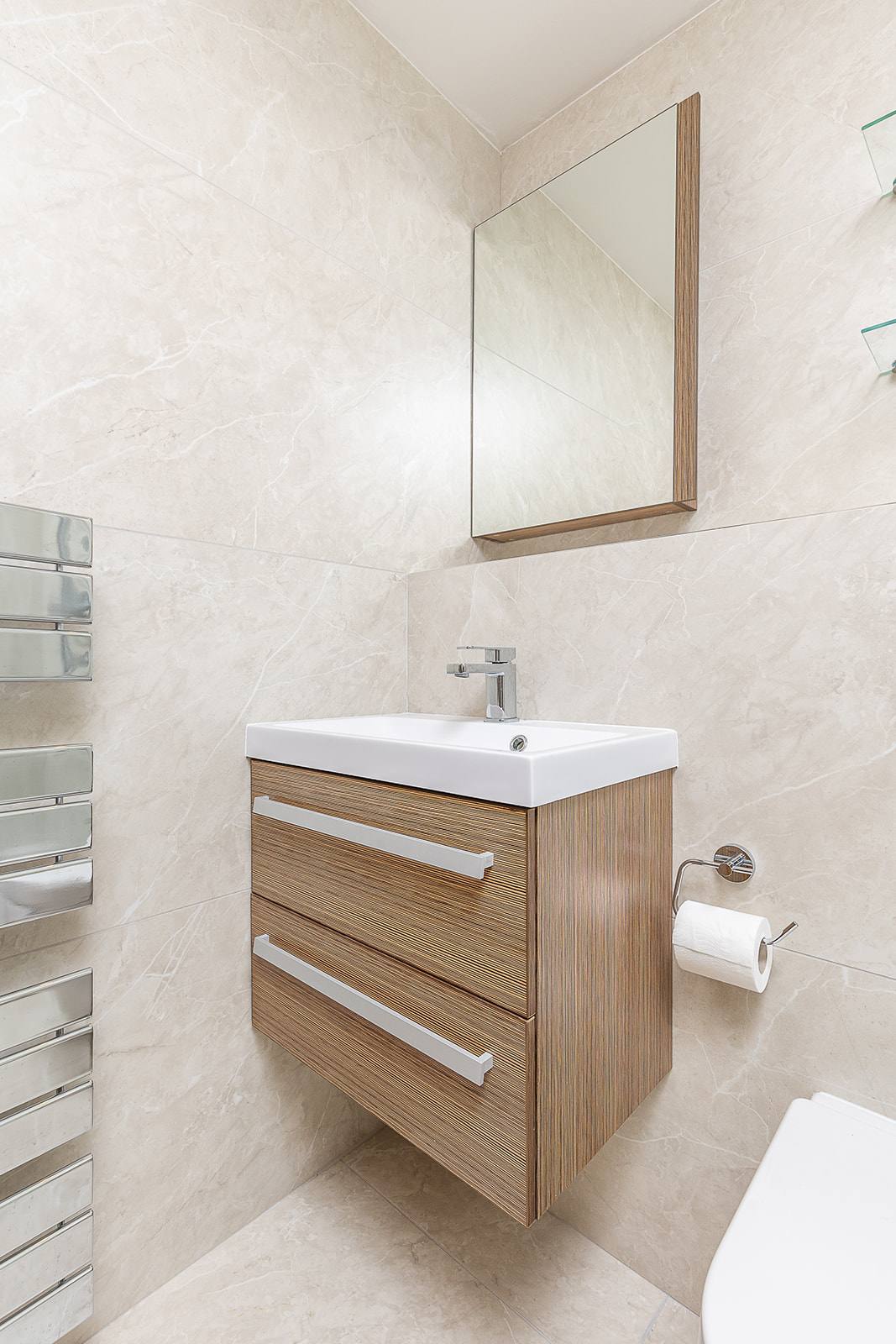
The Concept, Design & Specification stage is where the visual language becomes measurable. Tile dimensions are resolved. Joint widths are determined. Joinery lines are drawn to scale. The height of the mirror, the position of the tap, the depth of the shelf—these are not decorative decisions; they are ergonomic and spatial decisions that will affect the bathroom's daily usability and its visual proportion. We produce specification documents that are precise enough to guide a craftsman without ambiguity. We specify materials by actual product: not 'white tile' but specific porcelain, with specific sizing, specific grout colour, specific finish. This level of detail is the only way to ensure that what is built matches what was designed.
We have delivered bathroom designs for both residential and commercial properties. The London Embankment Apartment required a bathroom that honoured its period architecture while accommodating contemporary comfort. The Witham Project presented the challenge of reorganising a period home's bathing spaces whilst preserving original joinery and proportions. Tone at Canary Wharf demanded a bathroom that could service a commercial kitchen environment while maintaining visual coherence with the wider interior. Each required different solutions precisely because each space presented different constraints, histories, and functional demands.
During Commission, we oversee the fabrication of joinery and the procurement of finishes to ensure consistency with specification. We attend site during critical stages—tile laying, joinery installation, the hanging of mirrors and the fixing of hardware. We do not oversee projects from distance. We verify that the craftspeople executing the design have understood its logic and its tolerances. A bathroom that looks poor in execution was poorly detailed or poorly overseen, not poorly designed.
The Reveal is not a marketing moment. It is the point at which the bathroom becomes usable and daily. We will not know whether a design has succeeded until it has weathered six months of actual living. That is when tile joints behave as predicted, when storage proves adequate or inadequate, when the mirror fogs or doesn't, when the materials develop their true patina, when you understand whether the detail was necessary or excessive. We design bathrooms expecting to be judged by this standard: not how they photograph, but how they wear.
A bathroom design of restraint requires clear thinking and sustained discipline from both studio and client. It means choosing materials for permanence rather than novelty, accepting that a bathroom may not look as dramatic as advertised interiors, and understanding that the most expensive element is often the most invisible—the engineering of the drainage, the quality of the ventilation, the precision of the specification. We work with clients who share this understanding. A bathroom of quiet quality will serve its users faithfully for twenty or thirty years. That permanence is its credential.
If you are planning a bathroom renovation or new bathroom design—whether in a period property, a contemporary home, or a commercial space—we welcome a conversation about how your brief, your space, and your materials might combine. We are based in the UK and work across residential and commercial projects. We produce detailed specification before we propose methods; we supervise execution; we stand behind the permanence of what we build. The process is called Discovery, Concept, Design & Specification, Commission, Reveal. It is deliberate and it is thorough, and it exists to ensure that your bathroom becomes what you need it to be, not what a trend promised it would be.
The full Tone service range
Explore by area & sector
Frequently asked
How long does a bathroom design project typically take?
The timeline depends on the scope of work and whether the space requires structural or services planning. Discovery and Concept typically require 4–6 weeks. Concept, Design & Specification takes 6–8 weeks. Commission and execution depend on the scope of joinery and material availability. We do not accelerate specification to meet arbitrary deadlines; we complete it to the standard required.
Can you work within an existing bathroom footprint, or do you need to reconfigure the space?
We work within existing footprints. We also reconfigure spaces when layout, plumbing, or structural conditions demand it. The question is answered during Discovery. Some bathrooms improve through reconfiguration; others are better served by refined detail within the existing layout. We recommend based on what the space requires, not what would be more interesting to design.
What materials do you typically specify for bathroom tiling?
We specify materials based on the room's use, humidity levels, and the building's character. We work with porcelain, natural stone, and quality ceramic, each chosen for durability and appropriateness. Grout colour and joint width are specified to serve the visual proportion of the room. We do not choose materials based on current trends; we choose them based on their performance over decades.
Do you work on listed buildings or period properties?
Yes. Period properties require particular care in Discovery and Concept. We work with conservation constraints, preserve original features where appropriate, and ensure that new bathrooms respect the building's character rather than resist it. This requires detailed knowledge of period construction, plumbing options, and material standards that will read truthfully in a historic context.
How involved will I need to be during the design process?
We require substantial involvement during Discovery and early Concept, when we are learning how you use the space and establishing the material and spatial logic. During Concept, Design & Specification, we work more independently. During Commission, we update you on progress but manage the details directly. The best outcomes occur when clients are engaged in the decision-making phases but trust the detail work to be guided by specification rather than preference.
Walk YOUR home with Manong before a single thing is specified.
The Discovery is the first stage of every Tone Commission: a structured meeting at YOUR property or at the studio, where Manong walks YOUR brief with you and tells you plainly what she would do with the space. She is the designer on every Commission she takes, and the work is never handed to a junior. The Discovery is a paid stage, credited in full against the design fee if you both decide to go on, so YOU find out what YOU are dealing with either way.
Request a Discovery