Decorating affordably centres on identifying which elements will remain in your home long-term, then investing in those — and choosing restraint everywhere else. The studio’s approach begins during Discovery, where understanding how you actually live determines what matters. Quality matters most where you live longest; everything else follows a logic of durability and honesty rather than trend.
What counts as an investment piece in your home?
An investment piece is anything that will outlast your tenure in a property or your taste in decoration. For most homes, this includes the structural items: flooring, wall finishes, and fitted furniture. A reupholstered sofa keeps its original frame; that frame is the investment. The upholstery can change. In the Witham Project, the studio specified durable, neutral flooring that grounds the entire home regardless of how furnishings shift over time. This is how low-budget thinking actually works: you spend where permanence matters, you stay flexible where it doesn’t.
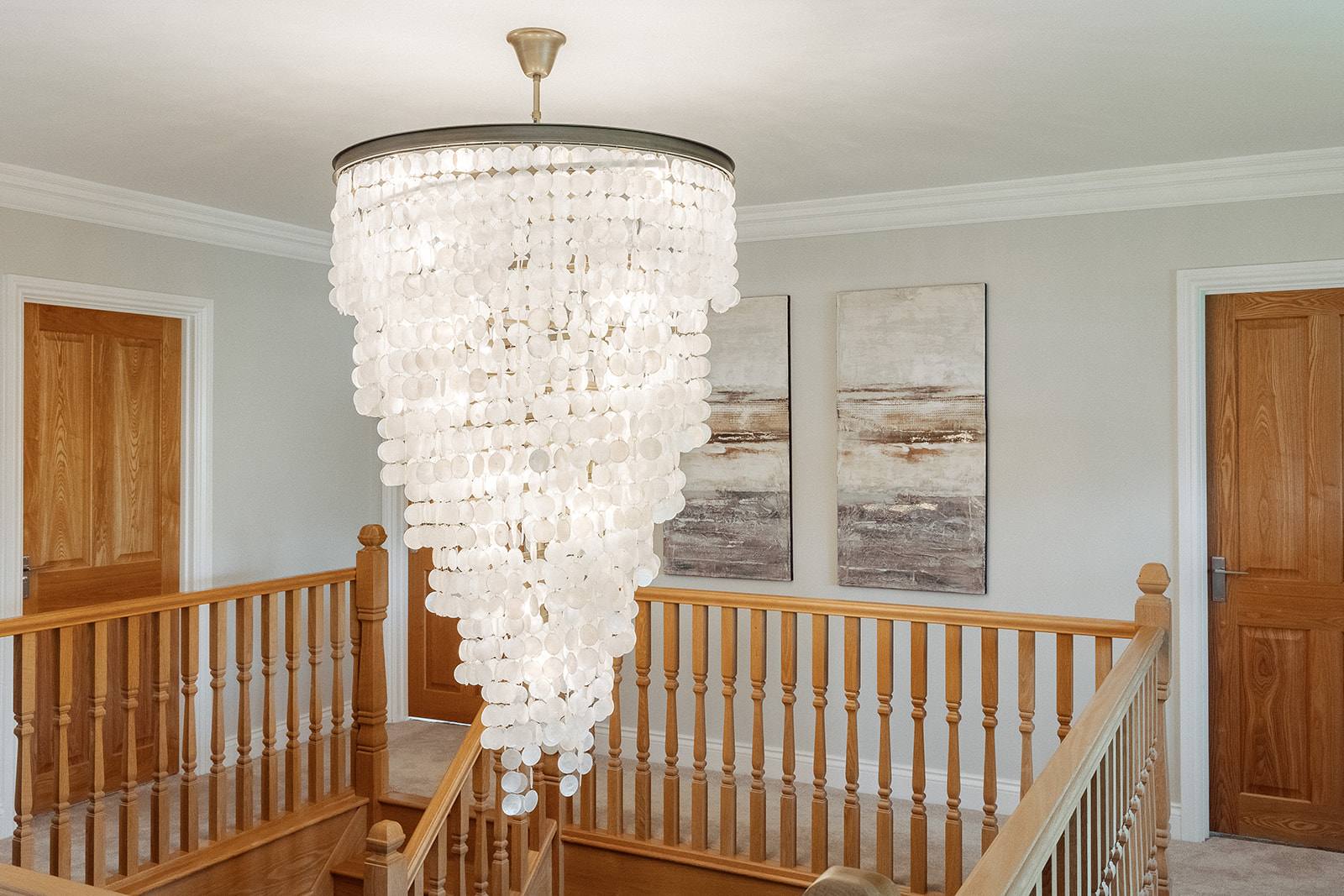
Lighting is another category that justifies investment. Poor lighting makes every other decision — paint colour, material choice, proportions — look worse. A single, well-positioned light fixture will serve a room for decades. Cheap lighting, conversely, requires replacement and often makes a space feel unfinished. The studio’s commercial work, including Fruittii Hair Salon and Beaulieu Dental Practice, demonstrates how investment in functional, considered lighting creates an atmosphere that makes every other element read better, often with fewer furnishings overall.
How do you identify what’s genuinely necessary in a room?
During Discovery, the studio asks how you move through and use each space. Most homes have far more furniture and objects than they need. A room with one perfect chair, proper light, and clear wall space reads as more luxurious than a room stuffed with multiple pieces. Restraint is not deprivation; it is clarity. In residential projects like the London Embankment Apartment, the studio’s Concept, Design & Specification phase focused on what could be removed rather than what could be added. This approach reduces the total cost of decoration because fewer items are needed, and the items chosen have room to be seen and used properly.
Start by listing the genuine functions of each room: sleeping, working, eating, sitting. Then list the objects that serve those functions. Everything else is decoration. On a low budget, decoration comes from proportion, colour, light, and material honesty — not from the number of objects in the space. The studio’s work across commercial projects like Keystones Estate Agent and Tone at Canary Wharf shows that a composed, minimal approach often costs less than a decorated one, because it requires fewer items and clearer specification.
Which finishes and materials offer the best long-term value?
Materials that improve with age rather than degrade justify their upfront cost. Solid wood, natural stone, quality paint, and durable fabrics require less replacement. Conversely, veneer, laminate, and cheap finishes often need replacement within a few years, which compounds cost. During the Concept, Design & Specification phase, the studio specifies materials that perform across time. In the Witham Project, this meant choosing finishes that would remain visually and functionally intact rather than deteriorate in high-traffic areas.
Paint colour is one of the cheapest transformations available. A considered, neutral base — whites, greys, warm creams — allows flexibility. Beaulieu Dental Practice and Fruittii Hair Salon both demonstrate how colour can define a space without cost; the difference lies in restraint and careful specification rather than budget. Cheap paint on poor surface preparation fails faster. Good preparation and mid-range paint outlasts cheap paint on poor surfaces. The investment is in process, not always in product cost.
How does the studio approach budget during Discovery and Concept?
The studio’s process begins with Discovery, where the brief is understood before any design direction is set. During this phase, budget is treated as a genuine constraint that shapes thinking, not as something to hide from. Understanding your actual constraints — what you can afford to do now, what can wait, what must remain — is the foundation of any sensible decoration. This honesty determines whether a project will feel considered or compromised. A small budget well-spent creates a composed home; a large budget poorly allocated creates visual noise.
The Concept phase then develops a direction that acknowledges those constraints. Rather than designing a vision and asking you to pay for it, the studio designs within what is possible. This is where restraint becomes a strategy rather than a limitation. The London Embankment Apartment demonstrates that a clear concept, well-executed, reads as more intentional and valuable than multiple half-developed ideas. The Reveal often surprises clients because a coherent vision, however modest in scope, performs better than a scattered approach.
Where should you compromise, and where should you hold your budget firm?
Compromise on trends, decoration, and temporary elements. Hold firm on spatial proportion, light, and finishes you will live with daily. You will change your mind about cushion colour; you will not change your mind about poor lighting or uncomfortable proportions. During Concept, Design & Specification, the studio prioritises the bones of a space — how rooms connect, how light enters, how surfaces perform — over decorative layers. Commercial projects like Tone at Canary Wharf succeed because they invest in clarity and function first; decoration emerges from that foundation.
If you choose one or two investment pieces — perhaps a sofa, a dining table, flooring, lighting — and keep everything else simple, the budget stretches further and the home reads better. This is not deprivation; it is the difference between a space that feels considered and one that feels makeshift. Keystones Estate Agent demonstrates how a small number of carefully specified elements creates an environment that feels professional and intentional, not sparse.
What questions should you ask yourself before decorating on a low budget?
How long will I live here? What activities happen in this room most often? What light does this space receive, and how can I work with it rather than against it? What one item in this room will I see every single day? These are the questions the studio asks during Discovery. Your answers determine where thought — and therefore budget — should concentrate. A home decorated by answering these questions will feel more complete and composed than one decorated by following a style or trend.
Finally: will this item still matter to me in five years? If the answer is no, it is not worth the budget, no matter how inexpensive it is. The studio’s approach to budget is ultimately an approach to time. Decoration that lasts, that improves with use, that supports the life you actually live — that is decoration that justifies its cost, whether the cost is large or small. The Reveal stage often shows that clients who thought restraint was deprivation discover they prefer the simplicity; the home is easier to maintain, easier to live in, and easier to adapt as their lives change.